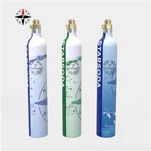

Aluminum cylinders are renowned for their corrosion resistance in a variety of environments, whether dry, wet, or low-humidity. This characteristic plays a crucial role in hospitals and the healthcare industry, as aluminum cylinders do not rust like steel when exposed to moisture, oxygen, or other medical gases. The aluminum alloys used to manufacture aluminum cylinders are carefully formulated to enhance the cylinders' corrosion resistance while maintaining mechanical strength and other desirable properties. These alloys are selected based on their ability to withstand all environmental conditions. When aluminum is exposed to oxygen in air, a thin oxide layer, known as passivation, naturally forms on its surface. This oxide layer acts as a protective barrier, preventing further oxidation and corrosion. It significantly prevents deeper penetration of moisture and contaminants that could cause corrosion.
Medical Oxygen (O2): Medical oxygen is a vital, life-saving gas, making its reliable and safe storage crucial to patient care and safety in hospitals and healthcare facilities. Medical oxygen can be stored in aluminum cylinders for long periods while maintaining its integrity and purity. Aluminum cylinders are less susceptible to corrosion, thus preventing the accuracy and performance of stored oxygen and protecting it from any contamination. Steel cylinders, on the other hand, are more susceptible to corrosion and rust, so oxygen extracted from them may contain iron particles and be unsuitable for medical use.
In Western and European countries, most hospitals and medical facilities use aluminum cylinders to store and supply oxygen to better ensure patient safety and care.
A University of Rhode Island study on internal corrosion of cylinders showed that:
Aluminum cylinders perform significantly better when humidity levels are constant within the cylinder, so oxygen stored in aluminum cylinders maintains its quality longer.
Medical Carbon Dioxide (CO2): Aluminum cylinders are ideal for storing medical CO2 because carbonic acid forms when CO2 accidentally comes into contact with moisture or moisture during storage. This carbonic acid can corrode steel cylinders and contaminate the medical CO2 gas. Aluminum cylinders, on the other hand, are unaffected by carbonic acid and do not corrode.
According to the ASM (American Society for Metals) Metals Handbook (1, 2, 3), aluminum and brass are not attacked by carbonic acid, but steel can corrode.
The American Compressed Gas Association warns in pamphlets G-6 and G-6.3 (4,5) that wet carbon dioxide can cause severe corrosion in cylinders.
Medical Nitrous Oxide (N2O): Medical Nitrous Oxide is widely used for anesthesia in surgical and dental procedures and pain management. It helps provide sedation, analgesia (pain relief), and relaxation to patients. Therefore, proper storage of Nitrous Oxide is crucial, as any contamination can compromise the primary components of the N2O gas, compromising the integrity of the gas and adversely affecting patients. Aluminum cylinders are ideal for storing N2O, as they are less susceptible to corrosion and are immune to any possible contamination. Steel cylinders, on the other hand, are susceptible to corrosion and may react with the N2O gas, causing contamination during long-term storage.
It is important to note that N2O cylinders are primarily used in specialized machines and equipment, such as anesthesia machines. If the installed cylinder corrodes, this can also adversely affect the function and life of the machine, and therefore many anesthesiologists now prefer to use aluminum cylinders with anesthesia machines. Likewise, aluminum cylinders are ideal for all other medical gases such as nitrogen, argon, Entonox, etc.