

Aluminum Scuba Diving Cylinder
| Specially designed for dive training centers, coastal resorts and marine rescue teams
Provide reliable and lightweight compressed‑air storage solutions for dive training centers, coastal diving resorts, yacht fleets and marine rescue teams. Solve the problems you face in scenarios such as group diving training, seaside rental‑fleet operation and cross‑border wholesale procurement where safe corrosion‑resistant diving equipment is critical. Holding ISO 7866 and DOT‑3AL international certifications, it supports bulk purchasing and OEM customization of cylinder colors, institutional logos and packaging.
Safety and Compliance
Each gas cylinder undergoes 100% water pressure testing, ultrasonic flaw detection and air tightness testing, and is accompanied by a traceable third-party certification report to ensure absolute safety.
Lightweight design
Compared with traditional gas cylinders, the weight is reduced by 30% to 40%, significantly lowering logistics costs and the operational load on workers.
Deep customization service
Supports OEM/ODM based on your filling gas, production line interface, and brand logo, including all-round customization in color, valves, size and packaging.
One-stop support
We offer full-cycle services ranging from technical selection consultation, compliance guidance to after-sales maintenance. Our professional engineering team is your strong backing.
| Drawing No. | Outside Diameter | Water Capacity | Length | Weight | Service Pressure | Test Pressure | Specification | ||||
| mm | in | liters | lbs | mm | in | kgs | lbs | bar/psi | bar/psi | ||
| MS-111-300-H- 01 (2~4.5)L |
111 | 4.37 | 2 | 4.41 | 359 | 14.13 | 2.8 | 6.17 | 200/2900 | 300/4350 | PED |
| 3 | 6.61 | 500 | 19.69 | 3.77 | 8.31 | ||||||
| 4 | 8.82 | 640 | 25.2 | 4.27 | 9.41 | ||||||
| 4.5 | 9.92 | 708 | 27.87 | 4.74 | 10.45 | ||||||
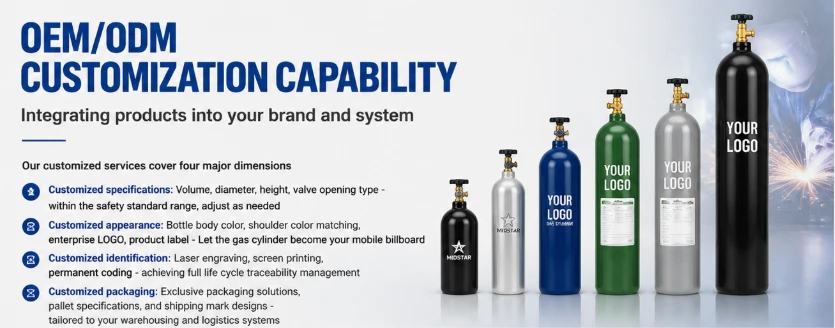
OEM/ODM customization capability - integrating products into your brand and system
Our customized services cover four major dimensions
• Customized specifications: Volume, diameter, height, valve opening type - within the safety standard range, adjust as needed
• Customized appearance: Bottle body color, shoulder color matching, enterprise LOGO, product label - Let the gas cylinder become your mobile billboard
• Customized identification: Laser engraving, screen printing, permanent coding - achieving full life cycle traceability management
• Customized packaging: Exclusive packaging solutions, pallet specifications, and shipping mark designs - tailored to your warehousing and logistics systems
From sample confirmation to batch delivery, we offer one-on-one dedicated account manager coordination to ensure that every customized detail is precisely implemented.


Scene One: Chain Diving Training Centers & PADI Certification Institutions
Traditional steel diving cylinders are extremely heavy. In daily beginner pool training, instructors waste massive physical strength carrying tanks back and forth, slowing down teaching progress. Steel tanks are prone to seawater internal rust after repeated use, polluting breathing air and triggering student discomfort. Mixed irregular tank sizes cause messy warehouse inventory, and unmarked steel tanks cannot distinguish different training classes, leading to frequent equipment loss. Small scattered retail orders occupy production capacity and squeeze training center profit margins. Midstar aviation aluminum diving cylinder cuts weight by 30% compared to steel counterparts, enabling instructors to carry multiple tanks effortlessly during group training. Marine-grade anti-corrosion inner coating avoids rust contamination, ensuring clean breathing air for trainees. Unified standard sizes simplify batch stock management for multi-branch training campuses. Custom printed institutional logos and exclusive color coding realize quick asset classification for different training groups, perfectly matching large-scale batch procurement needs of chain diving schools.
Scene Two: Coastal Resort Dive Shops & Yacht Leisure Groups
Seaside diving shops and resort yacht fleets operate in high-salinity marine environments. Steel cylinders corrode rapidly under long-term coastal humidity, requiring frequent hydrostatic testing and repainting, raising annual maintenance costs. Heavy steel tanks occupy limited storage space on yachts and dive boats, and increase vessel load and fuel consumption. Non-certified steel tanks cannot pass marine safety supervision inspections, delaying resort daily diving tours. Fragmented individual diver orders consume store staff energy and reduce operational efficiency. Midstar seamless aluminum cylinder features full saltwater corrosion resistance, extending maintenance cycles and cutting long-term operating expenses for resort operators. Lightweight design greatly saves boat storage space and lowers yacht transport costs. Complete ISO 7866 and DOT international certifications fully meet global marine safety audit standards, ensuring uninterrupted daily diving service. Bulk OEM color customization unifies the resort's brand image, supporting full-container bulk delivery for multi-villa, multi-yacht resort groups.
Scene Three: Global Diving Equipment Wholesalers & Marine Rescue Teams
Steel diving cylinders carry heavy dead weight, sharply raising sea freight costs for cross-border full-container shipments. Inconsistent valve threads and tank dimensions force wholesalers to stock multiple matching regulators, increasing spare part inventory pressure. Rust leakage issues trigger frequent overseas after-sales returns and damage brand reputation. Scattered personal diver retail orders waste warehouse space and customer service manpower, while blank unbranded steel tanks cannot launch differentiated private-label products for B-end diving business clients. Marine rescue teams need lightweight, portable tanks for emergency offshore operations, but heavy steel tanks hinder rapid rescue deployment. Midstar aluminum scuba cylinder holds complete international certification packages to smoothly clear customs of all major diving markets worldwide. Standardized valve interfaces reduce spare part stock pressure for distributors, and lightweight construction slashes comprehensive logistics expenses for bulk export orders. Full customization services cover tank colors, laser-engraved distributor trademarks and export shockproof pallet packaging. Wholesalers can shift core resources to high-value long-term bulk orders from dive chains, resorts and marine rescue organizations, instead of expending resources on low-margin fragmented retail orders.


Full-process support from concept to mass production: From drawing review, prototype making to mass production and quality inspection, we offer one-stop services, significantly shortening your product launch cycle.
Flexible cooperation based on demand: Whether it's a small-batch trial order or a long-term large-scale framework purchase, we can offer competitive tiered pricing and stable inventory planning.
Cross-industry application expert: Our gas cylinder solutions have been successfully applied in fire-fighting equipment, medical devices, diving equipment and the beverage industry. We are glad to apply our cross-industry experience to solve your specific challenges.


Regarding packaging
In order to deliver our products to you in the condition in which they were sent, we use strict, strong, efficient and environmentally friendly packaging methods.
Our standard packaging method for our products is to cover them with plastic bags, put them into cartons, then place the cartons on pallets and wrap them tightly with stretch film to ensure that the cylinders do not collide with each other during transportation. Other packaging methods can be provided upon request.

Certification system of Midstar
• U.S. market: DOT-3AL (U.S. Department of Transportation Standard for Aluminum Alloy Gas Cylinders)
• EU market: TPED /EU + PED /EU (Dual Directive compliance)
• International standard: ISO 7866 (Global Technical Benchmark for Gas Cylinder Industry)
• UK market: BS 5045-8 (UK National Standard)
• Chinese market: GB/T 11640 (National Recommended Standard of China)
All certifications are reviewed and issued by international authoritative institutions to ensure the authenticity and traceability of compliance documents.

Professional service commitment
We offer comprehensive support, not just products.
Bulk purchasing plan: Based on your annual purchasing volume, we offer tiered preferential prices and flexible delivery plans.
Customized services: Supports institutional customization of gas cylinder colors and markings, facilitating asset identification and management.
Training and Guidance: Provide training on product usage and safety regulations for your team.
After-sales service and Inspection: We offer regular safety inspection services for gas cylinders or assist in contacting qualified local inspection institutions.


Call to action
To the Procurement Managers of Institutions, if you are evaluating or updating equipment, we can provide you with:
Free sample experience: Test the lightness and reliability of the product in person.
Contact our B2B sales team immediately to get a personalized quotation and solution.

FAQs
Q: Are scuba tanks completely oxygen-free?
A: Compressed, purified air is used to fill recreational scuba tanks. This air contains approximately 20.9% oxygen. The use of pure oxygen in diving carries a number of risks.
Q: How long can a diver keep his or her breath?
A: Professional freedivers spend a lot of time training to understand and overcome the body's reflexes so that they can dive for up to nine minutes without using any breathing apparatus.
Q: Do scuba divers have more powerful lungs?
A: According to this study, divers have larger lungs than expected when they begin diving, and FVC may increase slightly due to adaptation to diving.